Feed on
Posts
Comments

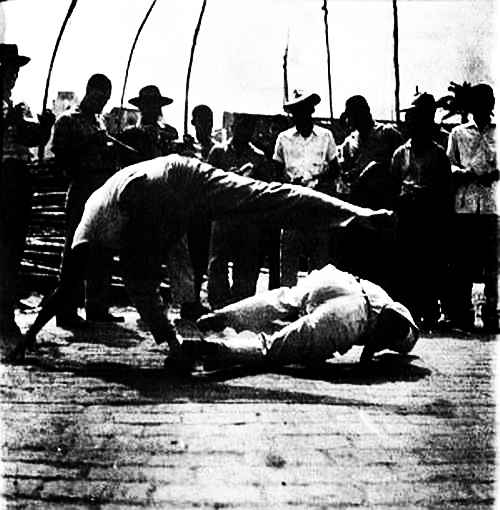
(photo by Emilio Navarinho)


Oxalá que me guie                                   Oxalá who guides me

Por todo caminho                                    the whole way

Nâo deixe na rodaa fé me faltar              Don’t let my faith fail in the roda

Sou vento que sopra eu sou capoeira      I am the wind that blows I am Capoeira

A luta de um povo prá se libertar            The fight of a people to be free

(Capoeira song translated by Mathew Brigham)


The people who were transported to Brazil brought with them the roots of Capoeira. These are not only the Martial Arts who came with them and who are the direct ancestors of Capoeira. There is also a lot of different religions which came to and started spreading in Brazil. It is impossible to mention all the manifestations of African belief in Brazil and it is also impossible to dig into every African religion which had an influence on African Faith in the Diaspora. This is the reason why I will just write about certain parts, just to give people an idea what to look for and as a kind of starter. If you are really interested into this topic you should do a more proper research than just reading this post, but start digging yourself. You will discover a very interesting and fascinating world, believe me!

When you ask a Capoeirista which religion might be closest to Capoeira the first or the second answer will be Candomblé. We all were taught that Capoeira itself does not have a religion and can and should be practised by all, but on the other side there are a lot of songs in Capoeira which actually refer to Candomblé belief and there are a lot of mestres who practise Candomblé. This is because Candomblé is, like Capoeira, an Afrobrazilian Tradition practised despite being outlawed and banned for hundreds of years, a way of resistance slaves practised despite the overpowering rule of their masters. It is a piece of this culture, which was as endangered as Capoeira and which did perceive similar demographic changes in the last 100 years. This is the reason why this post is mainly about Candomblé, its roots and its manifestation in Brazil.

The Yoruba Roots

Today’s Candomblé is strongly influenced by Yoruban traditions. That is why I begin with describing the Yoruban religion. Yoruba religion (or religions, if you dont want to see it as one whole) is the largest African born and developed religion in the world, practised by the relatively diffuse nations influenced by Yoruban tradition in West Africa. In Yoruba faith the world is made of two connected realms, Aye, the visible world we are living in, and Orun, the spiritual world, with its own inhabitants, with ancestors, nature spirits, and most importantly, the Orishas. Orishas are anthropomorphized forces of nature, associate with geographical features, extended families, towns and Yoruba ethnics dominant in these towns. Yoruba religion does know 401 (or, in other sources 601) Orishas, of which some are known and worshipped by all and others are only worshipped by certain families and towns. It is also important that every person is given a particular deity for worship. This is usually the deity the father or the mother did worship to, but it can also happen that a certain god does reveal itself in a dream and thus the believer will worship that particular god.

Among the Orishas there are some with special meaning and function. Olorun is the first Orishato be mentioned as he is the Creator of the entire universe and rules over it with the help of all the other gods, which are his children. He lives in the sky and has no special group of worshippers or shrines (while all the other Orishas do). This is the reason why some scholars do believe that Olorun was “invented” only later in Yoruba religion, being influenced by monotheistic religions like Islam or Christianity. But there are also other Orishas of great importance, like Shango, the god of thunder and fire, Ochossi, the hunter and scout of the gods and the god of those who seek for justice or something else, Iemanja, the loving mother of mankind and goddess of the sea. And there is Eshu, the divine messenger and trickster god. He is the one who connects the world of the Orishas with ours and he is the one everyone worships to, not only to establish the connection to the world of Aye, but also to stop him from tricking and consequently harming people (despite Christian scholars seing Eshu as Satan himself,  Eshu does not represent evil, because a) Yoruban religion does not have a dichotomous good-evil distinction and b) Eshu is merely a chaotic power necessary for everyday’s life and being a warning to those who do not establish a good connection to the Orishas).

Besides the Orishas there is the Egun. They are the spirits of the ancestors who assist and guide the believer through his life. On the other side there is also belief in reincarnation amongst the Yoruba, which does reveal itself in names like “Babatende“, which means “Father returns”. The Yoruba believe that, to lead a good life, you have to know your Orisha to worship and you have to know to align your Ori, which means literally “head” and which does come down to one’s spiritual intuition and destiny. Aligning your Oridoes mean that you establish a balanced character. To achieve this you have to work with the Orishas and folowthe guide of the Egun. To come to know your Ori is to come to know yourself, to achieve inner peace and satisfaction. Another important concept is the concept of Axé, which is the force that gives rise to all pocessesthat define the universe. Without Axé nothing would move, evolve or actually do anything. Roughly you can say that Axé is something like life force, although it is in everything, living and non living objects.

Roots of Candomblé

When the West African Oyo empire collapsed in the 19th century, a lot of ethnic Yoruba were transported to the Americas. Here they had considerable influence on the religious practises of the slave population, which were summarized under the term “Candomblé”. But Candomblé is not merely the Afrobrazilian version of Yoruban tradition. Candomblé exists in Brazil for 400 years, that is since a time when Yoruba slaves were only part of the slave population of Brazil. This explains why “Candomblé” is not a Yoruban, but a Bantu word. It comes from the root “Kandombele” which means something like “prayer meeting”, “festival” and “dance”. Thus, there are Bantu traditions in Candomblé, too. To understand the heterogeneity of Candomblé one has to remember that in the beginning slave masters were not fond of homogeneous groups of slaves on their farms. They feared that this would lead to allying and rebellions, so they took care that the slaves came from different nations and were speaking different languages. So Candomblé did evolve being influenced by many different traditions (thought the Bantu and Yoruba traditions are most visible). One example of this mixture of influences is that you can find Orixas from Yoruban, Vodouns from Ewe and Fon, and Nkisis from Bantu tradition in Candomblé. There is also some influence of Islamic Malés and their traditions, but this one started to decrease since the import of Islamic slaves was stopped after 1835 and the remaining once were forced to change to Christianity. And there is some strong influence of Christianity, which I will come back to later. Important to know is that the mixture of traditions is not causing problems in Candomblé. Some Vodouns, Nkisis and Orixas do have same or similar functions, but nobody does exclude the one or other deity because of this. The deities are recognized as different, but equal beings. And Candomblé is not the only religion in the Americas with mixed influences. Yoruba, for example, did not only have an influence on Candomblé, but also on other traditions like Palo on Cuba and the Dominican Republic, Umbanda in Brazil and the Petro rites of Haitian Vodoun.

Syncretism with Christianity

The Portuguese masters didnt like their slaves practising African rituals and religion. That’s the reason why a lot of slaves were forced to convert and participate in Catholic mess. This was the beginning of the Syncretism which evolved between Christianity and Yoruban traditions influencing Candomblé. Although the word Syncretism is a bit disturbing, as syncretism is “blending of two or more religious systems into a new system”. Christianity was not accepted by the slaves (at least not in the beginning), but forced into their lifes. And the blending of their traditions with Christianity was not because they thought some ideas of Christanity are actually good, but because there was no other way. And here we come to a concept, which every Capoeiristaknows by heart. The concept of “hidden resistance”, of deception and trickery, for the cause of survival (of one self, of one’s traditions, of one’s religion…). A lot of slaves did not accept Christian religion as such, but did use the saints for hidden worship of the Orixas and a camouflaged pracise of Candomblé. They learned names and characteristics of the saints and saw similarities to their Orixas. So they started serving those saints, with the casual hidden relic of the corresponding Orixa on the Christian altar.

O Santa Barbara de Relampué,
O Santa Barbara de Relampua.
O Santa Barbara de Relampué,
O Santa Barbara de Relampua.
E Relampue, de Relampuá.
O Santa Barbara de Relampué,
O Santa Barbara de Relampua.
De Relampue de Relampuá.

The song given above is for example not praising St. Barbara, but Iansá, the cleaning force and goddes of the storm and wind, wielding thunderbolts. Other corresponding saints are e.g. St. Sebastian for Oxossi, the Virgin Mary for Yemanjá, and Jesus for Oxalá. Today this Syncretism goes on. This is not only becauseof the pressure applied by the Christian slave masters, but also because there is a high degree of tolerance in African religious tradition. Believers did’thave problems regarding Jesus and the saints as equal deities. They did the same with Nkisis and Orixas and Vodouns. And they also did include other non-African deities, like Native American deities, which were seen as “Orixas of the Land”.

Candomble in Modern times

Despite being banned by the Catholic church and despite being criminalized by various governments, Candomblé did continue to exist in Brazil for hundreds of years (just like Capoeira). It did not only continue to exist, it did also expand considerably in the late 1800s (just like Capoeira!). This was due to the increased import of Youba and also to the influence of freed slaves and their religious practise. It was three freed African women who opened the first official Candomblé temple (”terreiro“) called Engenho Velho in Bahia. They were called Iya Deta, Iya Kala and Iya Nasso. Bahia was and is the centre of Candomblé belief and practise. Beginning with the Engenho Velho, other terreiros followed. Some did split up after several disputes (just like in… you guess it…) and the new Candomblés did orientate themselves upon certain African traditions. That is how the different “sects”, the “naçŏe“s (nations) of Candomblé did evolve. The traditions leading to the nations were existent before and were preserved by a Catholic Institution, amongst others. How? Well, at a certain time the Church did organized socalled irmandades, Brotherhoods for African slaves of the same ethnicity in the 18th and 19thcentury. This was meant to facilitate preaches in the slaves’ languages, but did ultimately lead to the preservation of a lot of traditions and their introduction into the practise of Candomblé. Today there are the nations of Candomblé de Ketu, Candomblé de Angola, C. de Jejé, C. de Congo, C. de Ijexa, C. de Cabocloand so on, each with a different set of main deities, different music and languages used in ritual. The nation of Ketu (or Queto in Portuguese) is the one with the strongest Yoruba influence and the one with the highest number of believers. Today there is as many as 2 million practicioners of Candomblé throughout Brazil. People from all social classes and all ethnicitiesstarted practising Candomblé in the last hundred years, not only because people believed in it, but partly to find back their roots, to solidarize with the Black people’s fates, partly because it was chic or becauseit was exotic, or as a protest against the Church. The same demographic change happened with other Afrobrazilian traditions, like Capoeira. Other than the 2 million “official” practicioners of Candomblé there are a lot of nominally Christian Brazilians who do occasionally engage in Candomblé rituals. This is because religious practices are not mutually exclusive in Brazil. On the other side there are of course people who do see things exclusively. In Candomblé there is the concept of Pureza which does imply the original African traditions of Candomblé and people trying to apply the Pureza try to cleanse Candomblé from Christian influences, creating a pure Candomblé (reminds me of the Angola movement in Capoeira…).


OK, as I said, this post is meant to be introductory. There is a lot of things I havent written down, just to streamline this post. My best advice is for you to inform yourself, if you are interested, and remember to be critical and remember that a lot of Afrobrazilianhistory was actually burned in 1888. On the other side it is important to say that Capoeira is not Candomblé. They are both expressions of Afrobrazilian culture, both have their roots in Africa and there are a lot of connections between both. And both have to be respected as traditions which grew over hundreds of years and are existent in modern society. But Capoeira is, although it is a lot of other things, not the practice of a certain religion.

Axé!


Some interesting sources used for this post (by far not all + not sorted according to information richness):

http://www.agogo.nl/MultiMedia/lyrics/Capoeira_Song_Compendium_Version_1.0_International.pdf

 http://www.anthrosource.net/doi/abs/10.1525/an.2006.47.5.28

http://www.bahia-capoeira.com/blog/index.php?itemid=15

http://www.mythencyclopedia.com/

www.everyculture.com/Africa-Middle-East/Yoruba-Religion-and-Expressive-Culture.html

(Jean Baptiste Debret, 1835)

More than 3 million Africans were enslaved in Brazil before the abolition in 1888. The Portuguese did, for economical and political reasons, have only access to certain African people, which is the reason why most of the ancestral nations of today’s Afrobrazilians are known.

In this first post of the African Roots series I want to begin with the uttermost basis of Capoeira. That is: the people who were brought to Brazil. The people which did not just bring their bodies with them, but also their beliefs and their knowledge.

The Portuguese had two major sources of slaves, the Sudan people and the Bantu people. The Sudan people were native to West and Central Africa. Sudan people being a summarizing word for different nations, like the Asante/Ashanti, Mandinka, Yoruba, Igbo, Fon and Adangbe. The Bantu people were natives of South-West Africa, living in the areas which are present Angola, Mozambique and Congo. All of these cultures and nations did add to the diasporic culture evolving in Brazil, the other South American states, the Carribean and North America. Usually because of sheer numbers there are nations which had a bigger influence on diasporic African culture than others. I will now concentrate on them rather than digging up information about every nation which “contributed” slaves to the Americas. The most influental nations were the Mandinka and Yoruba people from West Africa and the Congo and the Mbundu people from the old Southwest African Empires.

As I already posted some information about the Mandinka, I will first start with the Yoruba.

The Yoruba

The Yoruba are a common word for different tribes which are loosely linked by geography, language, history, and religion. In Nigeria, Benin and Togo the number of Yoruba people is about 15 million.

History

As far as history can say the Yoruba were always there. There is some archaeological evidence that the area where the Yoruba live is occupied since prehistoric times. Other theories say that the primary ancestors, the Odudua, came from Egypt. These are based on the fact that there are similarities between early Egyptian and Yoruban sculptures (though this can also be just an effect of trade or intercultural cross-talk). According to Yorubas myths, the founders of the Yoruba states were the sons of Odudua. The Yoruba still refer to themselves as “the children of Odudua.”  Although they had a common origin, a common language and common believes the Yoruba never had one single political organization. They were more organized into up to 25 different nations with urban centers as the center of political, economical and cultural life. The Yoruba were the most urbanized Africans in precolonial times. Of the urban centers, Ile-Ife is universally recognized as the oldest and ritually most important Yoruba city. The founding of Ife is believed to date to about 850 AD. Its biggest rival, the Oyo kingdom just to the northwest of Ife, was founded about 1350 AD. The Oni of Ife and the Alafin of Oyo are still the most highly respected Yoruba kings in Nigeria. Other major kingdoms were Ijesha, Ekiti, Shabe, Ketu, Egbado, Ijebu, Awori, Ondo, Owo, and Itsekiri. By the 18th century a lot of wars between Yoruba states did add to the slave trade and on the other side, were also affected by the political, economical and demographical challenges of the slave trade. Slaves of Yoruba descent were resettled in Cuba and Brazil, where elements of Yoruba culture and language can still be found.

Religion

I will only shortly describe the religion of the Yoruba. Not for the reason that there is not much to tell, but for the reason that a lot of Yoruba will come up in the later posts (actually in the following post) and that I dont want to state here things which would be better in the next post. Important to know is that the Yoruba had a very strong influence on belief systems in South-America and the Carribeans.

In the religion of the Yoruba there are important beings like kings, ancestors and deities. The number and the interrelationship of the vast numbers of gods the Yoruba have (according to the Yoruba it is 401 gods) remindes me of the Ancient Greek with their rich mythology and immense number of stories. These deities, known as Orishas, are also known to Carribean and South-African religions like Candomblé (and yes, the next post will be about Candomblé and other belief systems of the African diaspora).

Art

The Yorubas are famous for their art and craftwork, especially for their wood sculptures, which are important even in modern times. Carved doors, drums, and ritual masks are important articles of Yoruba art. The doors are often covered with carved panels of scenes of everyday life, history, or mythology. The masks are more facial carvings that represent different types of Yoruban religious entities like the trader, the servant, and the seducer.
Other than wood carvings the Yoruba also have beautiful sculpture work in brass, terracotta, and steel.

The Congo

The Congo (”hunter”) people, or Besinkongo or Bakongo, as they refer to themselves, are part of the loosely connected ethnic groups known as the Bantu. There is about 10 million Congolese people living today mostly on the African Atlantic coast between Brazzaville and Luanda.

History

The word Bantu does refer to over 400 ethnic group in Sub-Saharan Africa and a language diversity similar to the diversity of the Indo-European languages. The Bantu seem to be descendants of a “proto-tribe” which went through a huge expansion phase in the last 5000 years (we have to keep in mind that this expansion was mostly not an active war on neighbouring tribes, but a kind of diffusion of the culture and the language companying the one or other occasional movement of people from one place to the other). Around the year 500 BC the Congo people did arrive at the area of the Congo River. They arrived as settlers and did engage in iron work and agriculture since then. During the 2000 years of pre-Colonial Congo there were a number of kingdoms built up by the Congo people, including the Kingdom of Kongo, Ngoyo, and the Loango kingdom. The Kingdom of Kongo does play a very important role in young Congo history. It was presumably founded around the year 1100, the first recordings being around the end of the 15th century.

First contacts after the Portuguese “discovered” (right, as if the Congo people were lost or did’t know where they are…) the Congo Empire in the year 1482 were respectful (in comparison to later times, not in terms of common decency…) with Congolese nobles visiting European courts (or being presented there). On the other side there were attempts to Christianize the kings of Congo, which seemed to have worked with “Nzinga a Nkuwu” who was baptized as Joao I. in 1491.

When the Kongo people had to defend themselves against the Yaka in the mid of the 16th century, they asked the Portuguese for help, who came and stayed. Congo was officially colonized by 1885. Before then the Congo kingdom did lose his power in long years of bad governing and civil war. During these times a lot of Congo people were sold as slaves to the Portuguese. The starting point for most Congolese slaves was Luanda, which is a place still sung about in Capoeira songs. Luanda was founded by the Portuguese explorer  Paulo Dias de Novais in 1575. Since its foundation till 1836 it was the administrative center of the Portuguese slave trade.

Religion

One important subject of Congo religion are the existence of “spirits”, which can be ancestors, but also other spirits, which can inhibit objects. These objects, the minkisi (singular: nkisi) can act as chantments, protecting the person who wears them. Nkisi do also come up in Candomble. Most of the Congolese traditions in African Diaspora can be found in the Quimbanda (Macumba), an Afro-Brazilian religion. Yes, I’ll come to that in the next post :)

Arts

Congolese art is predominantly focussing on human beings and animals with a lot of sculpture work. Most of the Congo art is wood carvings, thought they ere also doing pottery arts.

The Mbundu

The southern neighbours of the Congo people were another ethnic group with a high importance for Portuguese slave trade, the Mbdundu. The Mbundu count nowadays something like 10 million people and share common traditions and their common language Kimbundu. Like the Congo people the Mbundu also have a disctinct history which changed drastically upon the arrival of the Portuguese. And like the Congo also a lot of Mbundu people were sold into slavery to Brazil and other Southamerican states.

History

 The oral tradition of the Mbundu does tell us that the founder of the Mbundu kingdom was a person called Ngola Kiluanje, who emigrated from the Congo and founded the kingdom of Ndongo. The kings of the Ndongo were called N’Gola, thus the modern name of the state of Angola. First records of Ndongo are from the 16th century when missonaries and adventurers did write down oral traditions of the Mbundu. In those times the Ndongo was a tribute state of the Congo Kingdom, although in later times the Ndongo did gain power with the help of the Portuguese (for all little Macchiavellists here, there is a classical example of divide et impera). The rest of the history of this kingdom does read like a classical story of the time of Colonialism with the exception of Queen Nzinga. Queen Nzinga was born 1582 to the Ngola Kiluanji. Special about this woman was that, once she succeeded in getting into power she managed to build up a coalition against the Portuguese attempts to gain power in the region. This woman was able to hold back the Portuguese in a time when those were thirsty for new land and new slaves to be sold to the growing agricultural economy in Brazil. This woman, who led the armies against the Portuguese personally, did manage to have a Peace treaty with the Portuguese by 1657 and died peacefully in the year 1663.

She is still one of the most important figures in Angola history and there is a statue of her in the center of the capital Luanda. Sadly soon after her death the Portuguese submitted the Mbundu in the year of 1671 and suffered under the slave trade and under Colonialism till the 20th century. Important about Queen Nzinga might be her role as a woman in Mbundu society. Mbundu society is strongly matrilineal and did have a lot of important female figures in its history.

Religion

The belief systems of the Mbundu are based on the interactions, praise and communication with ancestral spirits and nature spirits. Problems and difficulties in life are referred to as problems in the communication with these spirits. To solve these problems there was the Kimbanda, the diviner, who has the ability to communicate with the spirits. These diviners are still referred to when Angolans do have problems, although Christianity did enter the Mbundu society beginning with the very first contacts with the Portuguese.

Arts

Seated Woman - example of Mbundu Arts

Seated Woman - example of Mbundu Arts

 Mbundu arts are, when you find sources about them, usually intermixed witht the arts of neighbouring nations, as well as the arts of the Congo. As the Congo nations the Mbundu do have a lot of artwork with carvings. One speciality seems to be the Mbundu masks worn in rituals.


Well, that was the first part of the African roots series. Finally! And it was a lot of work! But I hope with this you have a basic knowledge regarding the question who came to Brazil?. this knowledge is needed to fully comprehend Capoeiras roots, because everything in Capoeiras history and present is somehow related to these people who came to Brazil (with the exceptions of some modern inventions, like cordas). In the next post I will refer about Candomblé, Macumba and - in general - religious believes of the African Diaspora outside and inside of Capoeira. Hope that you people will continue reading this series. If there is anything to comment on, or some information you want to see here, just post it under the comments. And if you are interested in more information, check out the links given at the bottom. They and others were the main sources for this post.

picture source: 

http://www.bibvirt.futuro.usp.br/index.php

http://www.kunstbuchhandlung.de/images/cover/1121972.jpg

http://upload.wikimedia.org/wikipedia/commons/e/ee/Jean_Roy_de_Congo.jpg

http://www.metmuseum.org/toah/images/h2/h2_1978.412.424.jpg

http://www.traveltonamibia.com/mbunduinfo.htm

Sources about the Yoruba (though this is not a complete list, but most of these sites have links to very good other sites!):

http://hearstmuseum.berkeley.edu/outreach/pdfs/yoruba_teaching_kit.pdf

http://www.postcolonialweb.org/nigeria/yorubaov.html

http://www.uiowa.edu/~africart/toc/people/yoruba.html

http://www.learnyoruba.com/

Sources about the Congo:

http://www.uiowa.edu/~africart/toc/countries/Angola.html

http://en.wikipedia.org/wiki/Bakongo

http://www.congo-pages.org/congoartnet/congo_art.htm

http://www.britannica.com/EBchecked/topic/757032/African-art/57147/Congo-Kinshasa-and-Congo-Brazzaville#tab=active~checked%2Citems~checked&title=African%20art%20%3A%3A%20Congo%20(Kinshasa)%20and%20Congo%20(Brazzaville)%20–%20Britannica%20Online%20Encyclopedia

Sources about the Mbundu:

http://countrystudies.us/angola/

http://www.bjornthegreat.com/angola/index.php

http://nzinghaofangola.tripod.com/

http://www.mnsu.edu/emuseum/cultural/oldworld/africa/kimbundu.html

I just found this on the web and thought people might want to watch it - while waiting for the first post of the African Roots-series. The first post is going well, by the way, I have now checked enough sources to write some coherent stuff.

So people, check this out, it’s wonderful and it is a clear evidence: Capoeira is old!

Ié!                                                    Ié!

Capoeira é uma arte,                       Capoeira is an art,

Capoeira é uma arte,                       Capoeira is an art,

Que o negrou inventou.                   which the negro invented.

Foi na briga de duas zebras              In the brawl between two zebras

que N’Golo se criou.                         the N’Golo did evolve.

Chegando aqui no Brasil                  As it arrived here in Brazil

Capoeira se chamou.                       it was called Capoeira.

Ginga e danca que era arte              The Ginga and the dance, which were an art,

em arme se transformou                 did transform into a weapon

Para libertar o negro                        to liberate the negro

da senzala do senhor.                      from the Senzala of the lord (slave owner).

Hoje aprendo essa cultura               Today I learn this culture

para me conscientizar.                     to increase my awareness

Agracedo ao Pai Ogum,                    Praise to Father Ogum,

A forca dos Orixás,                          the power of the Orixás,

Camará!                                           Comrade!

(Ladainha from Grupo Capoeira Angola Pelourinho*)


Starting aound 1550 the Portuguese started to import millions of Africans into Brazil. Over three hundred years, Black men and women were robbed and bought in Africa, treated like animals, transported over the Atlantic under unhuman conditions and had to work hard for essentially nothing. They were slaves.

Regarding those slaves who were imported there is one quote I read somewhere (I really dont know anymore where) and that is: “Those slaves might have come empty handed, but they did not come empty headed.” What came with them is their complete belief systems, music, rituals, world view, traditions, knowledge, language, arts, willpower and so on. And one thing which came with them is a form of dance/fight combining different concepts like beauty and strength, acrobatics and music, dance and violence.

Today’s Capoeira Angola does have a lot to do with awareness. Being aware of Capoeira’s roots, being aware that the African element in this art is of utterly high importance. Without it’s Africanity, Capoeira would degenerate into a fancy but soulless martial art. Capoeira, and especially Capoeira Angola, does live from its rituals, it game, its music and its history. In a discussion** I read and participated in on the Blog Mandingueira I realized that this awareness has to be maintained and increased in the present Capoeira Community.

But: Writing about Africanity in Capoeira is a mammoth task. Actually you could write a book about it and still would not have described everything there is to describe. 400 years of Capoeira practice mainly by Africans and Afrobrazilians did lead to the situation that every facette of Capoeira does have major African influences (admittedly there are European influences, too, since Portuguese lower class and sailors did start playing Capoeira in the 19th century and since Mestre Bimba started teaching white students). This is the reason why I will start the first cohesive series of posts on this Blog: African Roots. I hope that I will at least be able to give an overview about Africanity in Capoeira and I hope that there are people out there willing to add to the upcoming posts their knowledge about this topic, thus making these posts a richer source for people who make their first steps in exploring the roots of Capoeira.

Have an eye on this blog in the next few days. Cause then the first posts of the African Roots series will be published.


*if there are mistakes in the translation it is because of my lack of Portuguese. Corrections are welcome!

**special thanks to Kimbandeira for starting that discussion on Mandingueira

The other day I read a comment of a person called Kimbandeira on the Mandingueira blog. One question she asked in there was: “Do you actually know what Mandinga means?” When I saw this I thought “well, I do have an idea about it” and then I remembered that I actually had gathered some information of the word Mandinga but never put it together for a blog post.

So, now you think “oh, again some lessons in the meaning of the word Mandinga!”. No. I think the word Mandinga is quite well explained. If you dont know yet what it means, just check this post and the links in it. What I want to show you people is where it comes from!

The Mandinka

Mandinga is a word of African origin. In its form “Mandinka” or “Mandingo” it is the name of a huge ethnic group in West Africa(Mandinkas are one part of the Mandè ethnicity).  They have a common language, which is called Mandinka, and common traditions and history. Today there are about 11 million Mandinka scattered in the nations of Sierra leone, Guinea, Mali, Senegal, Gambia and more states of West Africa. Most of them are of Islamic belief though they kept a huge amount of their old traditions.

Mandinka history

Mandinka history as it s known begins in the Middle Ages. It is the story of the Manding Empire, or better known as the Mali empire. The empire existed from the 13th century till the beginning of the 17th century, where it collapsed under the power plays which happen in every kingdom at a certain time. It was founded by the magician Sundjata who belonged to one of the noble Islamic families who existed in West Africa. During its time the empire had a huge influence on culture and traditions in West Africa. It had a high standard of civilization and was one of the most urbanized areas in the world! One of its famous personalities is its king Mansa Musa (about 1300 to 1330), who was so rich that the value of gold dropped during the time he and his caravan visited Cairo (on his journey to Mecca, the Hajj).  

After its collapse different tribes among the Mandinka did engage in war with each other. During this war there was a lot of people driven to the Atlantic coast. Some willingly, a lot of them were caught and were made slaves. And just during those times the trans-Atlantic slave trade started to flourish. Today, a lot of the Afroamericans in North America are descendants of the Mandinka. But the slaves were transported not only to North America, but also to South America (especially Brazil).

The Malè Revolution

In Brazil Mandinkas and Mandés were known as Malé (which comes from a Yoruba word for “from Mali”). What was known about them was, they were Muslim and they were able to read and write, although it was ‘just’ Arabian script, but that was actually much more than most African slaves were able to. The theory says that this was a reason for the Malé being highly respected by other slaves. The Malé did in fact build up something like credibility in Brazil and were having an effect. Especially on one day: On January 24th 1835 a group of a couple of hundred muslim slaves and ex-slaves did several attempts to get hold of key positions in Salvador. Although this “revolt” was only one day and did end in the revolt being devastated and the number of the slaves decimated (and 9 Portuguese soldiers being dead) the revolt became a symbol for resistance of slaves in Brazil. It is not the first and not the only revolt in the New World and also not the most important example in Brazil, but it has its value in modern history. This is because it was just the endpoint of a long years resistance of Male slaves against their owners (the troubles happened during the years between 1807 and 1835). And it lead to a ban on import of Male slaves - they were just too dangerous. And during those times, when Malé slaves did cause trouble in the slave-driven society of colonial Brazil, the word Mandinga comes up, meaning much more than just “people of the Mandinka”, but meaning something like magician, priest or scholar.

To get a more detailed view of the history of the Mandinka and the Malé, just check these sources I have put together (and used for this post). The first two resources are highly recommended (and sometimes a bit hard to read, especially the second one). Anyway, enjoy!

Sources:

or: Visiting an unknown group/Roda…

Let’s face it. Most of the time a Capoeirista does spend his time with Capoeiristas he knows. He plays in Rodas where he  knows the rules. Most of the time, we spend or time in our groups. That is where we are most secure and thus, most confident. Even when we go to other places, most of the time, we take people with us. We have somebody to rely upon. We know, there is someone who is on my side.

But then there are the rare occasions where the only one on your side is you. When you visit another group. These are not the most favourable situations. It is pretty unsafe, sometimes. But it does have its own fascination.

Since a bit more than one year I had the possibilities to visit different groups and every time I visited a new group there was this great feeling. Something in between excitement, curiosity and fear. This feeling is especially strong if you are going alone. Because then it is only you you can rely on.

Here a couple of hints for the next time one of you people visits a new/unknown group:

1. Always try to make first contact before you arrive at their Roda or Training. It is a demonstration of respect if you ask the responsible person beforehand if you are allowed to come or not. The possibility that the teacher will say “no” is low, but this should not stop you from showing your respect.

2. When you arrive at the Roda/Training do try to make first contact with the teacher/mestre as soon as possible. This should happen before the Roda/Training started. Do tell who you are, where you are from and who was your teacher (these are the most interesting pieces of info the teacher will want to have). In this situation it is helpful to a) refer to a mail/phone call you made before and to b) refer to a teacher/mestre of yours that is known. Usually a teacher/mestre does respect other teachers, although they might not always be of the same opinion.

3. Do not insist on playing in the Roda. Humility is the word of the hour here. As you are a guest you do not insist in showing your skill in the Roda. The first thing, if there is a roda, is to offer playing an instrument. Do not grab the next berimbau unless the teacher said so. Offer to play one of the percussion instruments, like the pandeiro, the reco reco or the agogo.

4. Do not show off. One of the most important rules. It is never smart to show off when you are in a unknown roda. You as a stranger do have the attention of everybody anyway. So whatever you do will be measured and rated. Of course the more you show off the higher is the possibility that they try to find out where your limits are. If your limits do not go farther than your show off abilities than you are done and everybody will just remember “the show-off who came the other day and was at his limits in 10 seconds…“. Another reason why you should not show off is that you should always have a good pool of movements for the times when there is somebody who really wants to test you.

5. Do not expect to play the teacher/mestre. It never happened to me that the first game I had in a new group was with the teacher or mestre. Usually they did send somebody else in and watched my game before they decided to get in or not. This is absolute logical. A teacher/mestre does know that there are a zillion of capoeiristas out there with a lot of abilities. A stranger coming into there group could be a bad-ass violent maniac or just a semi-beginner with a couple of show off qualities. As the teacher does have the responsibility over the group he does take the tactically smartest option, which is seeing first what kind of player you are and then deciding if they go into the roda or not.

6. Try not to play hard.I know a couple of you people does play hard on others on a regular basis. Some of you people didnt learn it another way. And within your own group it is ok. Even when you are a bit harder on one or the other colleague the possibility that you get beaten up in your own group because you are too hard is quite low. There are other ways to tell you to loosen up, like your teacher just telling you this in a quite minute or two. But when you are visiting another group you cannot assume that they have the same rules. So the best thing to do is playing soft and see what kind of game the these people have. Actually it is even better to first watch their game and see if you really like to join or not. The problem is that most groups do have a different game in public presentations and during training. So do not assume that a group who has a soft game during a presentation will also have a soft game in their Roda.

7. Do not get nervous or sensitive when you are in the Roda and you realize that the people are playing hard on you. Or when you are playing an instrument and the teacher does correct your music, dont be oversensitive. It cannot be a personal issue they have with you, because they do not know you. If they are unfriendly, well, then you at least know that this visit was your last. And if you can save your face and do shrug it off, then you are “the winner”. If they correct you, do accept the correction. It will not influence your style if you do change your [insert name of the movement] for one day. Do not insist on one way of movement or music or the other. And if you get attacked in the Roda then respond reasonably. Do not use more violence then the other one uses in the game (this might lead to a violence spiral and you should mind that you are the one who has no friends around).

7. Do not criticize. This is actually self-explaining. But I have seen guests arrive and thinking that they know things better and thinking that somebody gives a s…t! It is deeply embarrassing if somebody does this mistake and does usually lead to you getting a lesson in humility by the teacher or one of his better students.

8. Be thankful.It is not your right to be at another group’s training or Roda. It is not your right to play in their bateria or in their Roda. So everything they let you do is actually a favour. Do treat it like this. Be thankful and do express it after the games and after the training or Roda. Go to the teacher/mestre and tell him. Even if you did not like it. A good “Thank you” at the very end might even neutralize some mistakes you made at the end.

9. Do not bitch around afterwards. What happened, happened. You got beaten up in that roda? Maybe not your fault but your responsibility. You went there, right? Nobody forced you. You did not like their game? That is OK. That is the reason why there are different groups. You did not like the teacher/the students? Well, the world is not perfect, right? Your opinion about what happened or what not is maybe very important to you, but refrain from going around and bitching about your experiences in the other group. If there is something wrong with that group than most people do already know anyway. If you bitch around, people will talk about it. And as you do not have control about where your bitching goes to (it might end up at the group where you just been yesterday) it is just better to remain silent.

And if you follow these rules and do go in there, knowing what abilities you have and trying to learn from the other group, then the only thing I can tell you is: Enjoy! It is one of the biggest and most exciting things in Capoeira, when you face another player you dont know in a Roda you dont know! Then you can show if you are a real Capoeirista or not!

AxÉ!

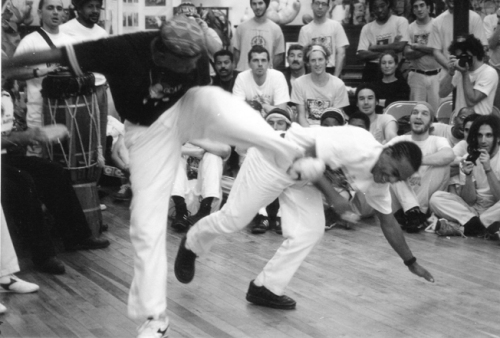
*picture source: www.capoeirayork.com

Street Capoeira

This topic is circulating through my mind since a couple of weeks. Maybe it is due to me leaving my first Capoeira group more than a year ago, which lead to me visiting groups and training with different groups - also regional, which is not really my line of Game. Anyway, during those times I started to see Groups and Academies differently. It is not that I do have a problem with all the typical group issues which can come up when you are in one (see Mandingueiras page for this, she has some pretty good posts in there!). I just thought about one question, and that is the question I am gonna contemplate upon in this post:

Does Capoeira really have to be stuck in Academies?

I know it is a provoking thought, questioning about 80 years of Capoeira History and a lot of teachers would decapitate me with a clean martello for this, but Capoeira did survive because people did have the flexibility of thinking in another way. So that’s what I am doing right now: Thinking the other way.

Of course “Bring Capoeira Back to the Streets” is a very placative exclamation and more an eyecatcher for you people than meant that way. No, I think without academies Capoeira would still delve in the marginality in which Mestre Bimba did find it 80 years ago and did lift it up into publicity. Without academies only some special ethnologists or Brazil-fanatics would even know what Capoeira is, nobody would play it and I would still not be able to do a handstand (and would have not chosen any sport at all for my life!). So academies do have a pretty big influence on what Capoeira IS today. Actually, Capoeira is almost only to be found in academies (or at least groups). In Europe and North America much more than in Brazil. I will later come back to the advantages of academies for Capoeira (I think most of you do intuitively know it anyway…). But much more interesting is: Why do I come up with the Streets at all? What is what Streets can give Capoeira?

I’ll name three advantages of Capoeira on the Streets and then name some disadvantages and why the academies are exactly at the right spot for this.

Pro: Capoeira on the Streets

Capoeira on the Streets

a) The first thing one have to think about is that Capoeira does actually come from the streets - or at least has spent a lot of time on the streets, in suburbian Brazil, on the docks of Bahia, Rio, Recife. Of course, I as an Angoleiro do say that Capoeira comes from African slaves, but some major changes were coming exactly from the time when Capoeira was played on the streets. It grew up in marginality, being chased down by the police and being frowned upon by “general” society. Then, some brilliant mind called Mestre Bimba did succeed in pushing through the academies and although society did not really accept Capoeira, yet academies were ok. It was some people doing that stuff between walls, out of the sight of the public (and if, then it was some kind of folklore demonstration…at least that was what people might have thought). It was a Capoeira being under control. If there was a problem with Capoeiristas you did not have to hunt down a solitude Capoeirista, but just go to his school - and the problem was solved. This everything was good for Capoeiras survival, and once it survived and was tolerated, it could start spreading around. Yeah, but on the other side it is now stuck in this academies. Even in Brazil you have so many academies and groups that usually there is always a Capoeira school some kind of Capoeirista belongs to. Does it have to be like that? Is not Capoeira, learned and practised on the street, some kind of a more authentic way of Capoeira? Less ‘imprisoned’?

b) And this leads to my second point in arguing for Capoeira on the streets. With Mestre Bimba’s academy, and the thousands of spawning academies which basically do form the Capoeira Regional and Contemporeana scene of today, a whole other way of teaching entered the Capoeira world. There were groups before, and the one or other teacher might have taught Capoeira in a more structured way. But the real structured way of teaching came to Capoeira in the wave of the academies. What is wrong with this? Well, structured and standadized ways of teaching do usually not concentrate on a single student’s needs, problems or strengths, but somehow takes “the average student” which is a non-existing prototype. After a while in the standardized training method, each individual student does come closer and closer to “the average student” leading to a whole bunch of students, which play alike! And that’s what is the problem of academies. You can actually see where a Capoeirista comes from, when you know a specific group’s style. That is true for every size of group, but when you have groups with thousands of students, then this becomes a problem. Capoeira is born and lives from its diversity. Thus, uniformity does kill it. And that is something which can’t happen that easily on the streets. When people learn by playing other people, they might take over techniques of one specific capoeirista, but there will be the influence of a lot of other players - leading to more diversity.

c) The last point I have is actually the most important, to me. With Capoeira in Academies you have one problem. They are not out there. And if they are, then Capoeiristas are part of a show, with sometimes defined people (who plays the berimbau? who does the acrobatics? who’s playing whom? and so on…). That is not the same as we are playing in our Rodas amongst Capoeiristas, right? This way Capoeira will have it hard to integrate into any society other than the Brazilian society. We are here, outside of Brazil, playing Capoeira since 30 years, and still I have to explain people what Capoeira is. It gets better, but most people actually have no idea about Capoeira, until they have trained it… for years. But if Capoeira is part of street culture, people will be able to recognize the sound of the Berimbau, be able to link Capoeira to Brazil and will get interested easier. It will stop being a rare phenomenon and finally find its place in the middle of society.

So, now enough advantages. There are also major drawbacks of Street-Capoeira.

Contra: Capoeira on the Streets/Pro: Academies

Capoeira Academy

a) My first pro-point was that Capoeira was something that was belonging to the streets before Mestre Bimba came along and did make some serious changes. It is, of course, a romanticized view to say that everything was better. Street Capoeira was having an existence in marginality. And this was not only because it was a black sport. It was also a violent game. This inherent violence made it troublesome, threatening and suspicious for ‘general society’. And these were good reasons to chase Capoeiristas. At least for the ’society’. (That a lot of Capoeiristas did the things they do out of poor desperation, or because there was no other way, that is something people do forget easily, but that is another topic.) Now let us go 10 years into the future and think of a Capoeira street scene somewhere in a major Norht American and European city. And suddenly violence does occur. Two groups/gangs of Capoeiristas do make use of knives in the Roda, or of shotguns… Well, welcome back to the situation of Rio in 19th century. I am exaggerating a bit, but where I am coming down to is this: Without academies there is no control of Capoeira at all. That is sometimes good for Capoeiras freedom, but we all know that Capoeira was also used for other purposes. And when Capoeiristas do become a source of trouble in other than Brazilian societies the reputation of Capoeiristas will drop into a grey area we all do not want to belong to. And it just needs a couple of stupid people for this! How does the oriental saying go? “When one idiot does throw a stone into font, ten wise men will not be able to get it out.

b) Another disadvantage of a street capoeirista is quite obvious and was obvious to a lot of old Mestres when they first saw regionalistas (the phenomenon is still existent today, though I think in a lesser degree than in the past). Street Capoeira does not teach you how to do things efficiently or beautifully or anything else. The degree of technique taught in a Capoeira Academy is - because of a streamlined and structural way of learning - higher than on the streets. Because of this we have more highly developed Capoeiristas than ever before. There is even still a difference between Regionalistas and Angoleiros. Angoleiros do usually receive a less structured lesson than Regionalistas. This does lead to the fact that Regionalistas learn playing and do achieve high performance faster than Angoleiros. Learning Capoeira Angola does need more time - with the advantage of pretty individualized styles. But even Angoleiros today do have much more structurized training than people had before.

c) The last point I have against a street capoeira scene is actually a direct response to my last pro argument. Capoeiras integration into society and a street Capoeira scene in Europe and North America (and Asia, Africa or Australia) would change Capoeira itself. It would generate some kind of local Capoeira, which is in danger of losing its roots. As an Angoleiro I am very considered that nobody forgets what Capoeira was, what the traditions are and that the Game does not lose its characeristics. Without an Academy the danger of losing Capoeiras identity is very high. When you think about it, MEstre Pastinha’s academy did evolve especially because there was a need of saving Capoeira Angola was felt. Maybe only this and the efforts of people organized in academies did save Capoeira Angola. And that is something I should not forget myself - e.g.when I am contemplating about Capoeira on the Streets yes or no. Capoeira might loose its cultural roots.

So where do we land at the very end. Should Capoeira go back to the streets? Yes and no - as it is with everything in the world, right? I think the invention of academies did save Capoeira and make it so big and this will continue. Without the academies the Capoeira world will shrink, diffuse or drift into a position where it is folklore or a violent game. Both nothing we really would like to have. And what can we do about this. Well, first of all: Belong and do not lose contact to one or other academy. They are the basis of Capoeira today and there are pretty good reasons to leave it like that. And on the other side - if your teacher does allow it - play on the streets. Do play with other people, meet up and do something. Let’s live Capoeira!

Axé!

 Pictures taken from: www.salvador-portal.com , www.wikipedia.org and www.achebrasil.com

I realized the other day that I did write mostly about serious topics. That is ok, cause, well, Capoeira Angola is something I take serious. But as important as all the cultural aspects and the little rules and the philosophy of capoeira is the fact that Capoeira Angola is FUN!!! I sadly dont have any real footage showing me playing (if I do I’ll promise to post it!), so I decided to post my favourite Capoeira Angola youtube videos this time. I will also say one or two things about them, although, most of the time the videos are talking for themselves.

The first video does show a footage I have already in my history page in this blog. It shows the two Grand Mestres of Capoeira Angola, Mestre Joao Grande and Mestre Joao Pequeno, playing.

As these guys do not get younger but are still alive and kickin’ and it is just a great atmosphere to see 160 years of Capoeira Angola in one circle the second video is also one of my favorite ones.

There is a lot more and many other videos from mestres I admire. One of them is Mestre Cobra Mansa (of course!) and so I want to put one of my absolute favourite videos in here, too. He is playing Mestre Ponchianinho here, from Cordao de Ouró. It is also one of the proof videos that Capoeira Angola does have a rough game, too.

But on the other side, there are also very beautiful games which do not show (much) antagonism. The next video is a premium example for this. It shows two students of Mestre Jogo de Dentro and there almost perfect interplay in the roda.

Some other Mestre who is just plain very interesting in his style is Mestre Camaleao, who seems to have a huge amount of moves I’d never dare to use in a roda (out of fear that my opponent would kill me afterwards!). He is also a rough player, at least in this video.

Another video is actually a footage from a whole DVD which is quite high on my to-buy list. It’s from the DVD Ypiranga de Pastinha. If somebody knows where to find it. TELL ME! :D

Although it is the third time that I have Cobra Mansa in my video collection this video is not about him but about a 10 year old boy who is definitely somebody I should keep in eye! Check him out!

And last but not least a bit of a musical final. A guy getting interesting sounds out of the Berimbau!

I hope you enjoyed this little collection of Capoeira videos. And my message for this post is quite simple. Never, never forget that Capoeira and Capoeira Angola is for joy!

I would also like to see what YOU people like. Which youtube videos can you recommend?

Revenge in Capoeira

A little test by the side: You are playing Capoeira in a Roda. Your partner in this circle is better than you are, which is - per se - nothing bad. At some point he does turn his upper body and your inner eye already sees the leg speeding towards you head, so you move into an Esquiva. Suddenly your partner stops his movement, turns his body into the opposite direction and the back of his hand slashes through your face. Several people in the Roda start to laugh. You are angry. What shall you do?

a) Smile. And then directly attack with the worst movement you have in your repertoire.

b) If he uses his hands, you are not gonna back up. Smack him.

c) Alright. He made a nice movement. But attacking him wont solve any problems. So you just shrug it off and swallow your pride.

d) You swallow your pride. But you will never forget. Next time when he doesnt expect it, you will give him back the exact movement he did to you.

So, which option is right? Which is wrong? The experienced Capoeirista will say now: “There is no right or wrong. But there might be smarter moves and not so smart moves, depending on the situation.”

So, no option of the four given is wrong, but one thing I can say (and most of you will think the same). Option d) is used only very rarely.

And now I am gonna tell you something what I heard from Capoeira Angola Mestres and teachers. There is the possibility to “keep” a kick. You get a kick and that one was somehow humiliating (for you)? Keep the kick or the attack in mind. And at an appropriate time, give it back to the same person who did that to you. This appropriate time - at that is the clou about “keeping” - does not have to be the same jogo, or even the same day. You just wait until you see the perfect opportunity. Even if it takes years. And then you strike. I just want you to keep in mind that this option exists. It is not said that all the other options given in the beginning are wrong or right, you can directly strike if you want so - or just forget about it. But there is also a third way.

Ok, now you know that it exists, but apart from the pure existence of this concept there is much more about it. A philosophical aspect which is much more interesting than the pure fact that you can revenge an attack years later. This aspect is malicia in its purity.

First of all: What is the advantage of this approach? I, for example, do not always play fair. When I get angry, tired, bored or when I see that I am physically overpowered I do use some small tricks to at least embarrass, if not annoy the crap out of my partner - or to overpower him by pure Malicia. Sometimes I just DO kick, even if I could also not kick. Everytime I do one of these attacks or fintas I know that my partner will not like that. Thus, I know he might feel the urge to answer me in a proper way. Usually such an answer comes directly. So, directly after a mean movement of mine, I am usually very careful and harder to catch than in other times. But when the other person “keeps” this kick he has the choice and he will chose a time point where I seem secure - and then he will give me crap back. This is Malicia and as Capoeira is not just pure technique and speed and strength, Malicia is an important part of everything.

But isnt this unhonourable? And isnt revenge a bad thing? Those question can come up. People who ask these questions usually do not see the background Capoeira is coming from. Capoeira was a tool for survival. It was the sport, the art of the African slave who had no rights and who also had no luxury to be generous. Nobody was generous to him. If he did a mistake, he was killed. Africans didnt have the luxury of being equally treated, they were literally called ‘pieces’, they were ‘goods’. You trade them, you use them, you throw them away. And after the abolition of the slavery in Brazil 1888 this did not change. After that Black Brazilians were not slaves, but did have little rights. Jobless, Rightless and without any social value, a lot of Blacks landed in the suburbs of the bigger cities. Here they tried to survive. In a world which does not care about honour. What those people do care about was Do I survive or not? and that did include some unfair measures. This did include some malandragem. Capoeira grew in these times and learned a lot about life. Capoeira is the philosophy of the small man, who already has seen misery. Honour and Truth and other virtues are nice, but at the end they do not feed your stomach. And the same does apply to the Roda, as it is a representation of the world. Once in a while rules are broken. And if this happens you better be prepared. And once in a while - and now I am coming back to the revenge - it is not a good idea to revenge a received kick directly, but to wait, wait until the one who gave the first kick does forget. This can be much more efficient and is much safer for you as a player than direct response, because, as I said, the other one does expect a fast reponse. This all comes down to one truth I heard once (or maybe read, I’m not entirely sure about that):

The violator will forget about his victim, but the victim will never forget the violator.”

There is another lesson Capoeira gives in there: if you are unfair to a person, do not be surprised if you get that back. Now think about it. Did you ever beat up a Capoeira player which was not as good in Capoeira as you are? Did he left afterwards, or after a while? What if you two meet up in a roda in 5 years, and you did already forget about the violation? Do you think he did forget? I for myself do know who kicked the crap out of me while I was still a bloody beginner. I do remember, and if I have the opportunity, yes, I might use it (although I have to admit that it was a teacher in those times and I think even today he will be able to beat me up, so I might have to wait a couple of years more…). So, if you didnt beat up a beginner yet, do not do it at all. It is not only a bad thing to do (as I said, Capoeira does not take care much about morale…), it is also not smart, because you never know how that person takes it. Be always nice in the Roda, at least to those you do not know. You never know if that person might take it’s (just) revenge in 10 years!

And how do we use this in our daily life? We all know that Capoeira gives lessons in life. The lesson here is quite easy. a) Do never let urgency or anger set the time when you respond to another person´s acts. b) Or even if you do, do know that that person will expect it. c) Do wait for the perfect time to do some things. Sometimes the perfect time is immediately, but not always. Do keep this in mind. And d) do not mistreat a person because you are able to. If you really have to do that, do mind that the other person will want to take her revenge, if not now, then later. Be prepared.

Once upon a time… I was biking to a Regional training and a girl who was riding with me asked me: “Why do Regionalistas admire Angoleiros ?”

Well, I think I was the wrong person to ask, because I am an Angoleiro and before I came into contact with regionalistas I didnt even know that there was some kind of admiration there (and I met a couple of Capoeiristas who were braindead saying things like “man, you are doing granny-stuff” - they never went into the roda with me). Maybe I should ask you people: What is so special about Capoeira Angola?

Well, of course I know the differences between the different styles of Capoeira. And I know what I miss when I see a Regional game. I miss a lot of aesthetics, interactions and trickery. I miss the surprise element and I miss the magic (yeah I know, very precise word, magic…) in it.

And while I was thinking about this, some other question came into my mind. What if somebody came to me and would ask the question given as title of this post: How do I become an Angoleiro?

Well, the easiest way to become an Angoleiro is to exclusively train in a Capoeira Angola group. Be careful: I am not saying that it is the only way and I am definitely not saying that, if you like to train in a modern Capoeira group, that you should stop immediatedly. What I am saying is, just, that it is the easiest way. I did play 6 years of Capoeira Angola before I started taking lessons in Regional. And I realize that I will stay an Angoleiro forever, because it is imprinted in my body. I move like an Angoleiro, I play like an Angoleiro, I am an Angoleiro!

If you did train in a Regional group first, it takes time to get the Regional out of you, if you want to be an Angoleiro. And the longer you played Capoeira Regional before, the longer it takes to get rid of that “imprint”. In that case, it does help for the first few years to stop playing with regionalistas completely and focus on the Capoeira Angola training. Once you move and play like an Angoleiro without having to think about it, then it is not a problem to play Regionalistas anymore. Otherwise playing Regional while still learning Angola will inhibit your progress in learning Capoeira Angola.

But is it impossible to learn both? When I apply pure logics to it, I’d say no. It is not impossible. But you have to understand first that the difference between Regional and Angola is not the speed and playing low. Some people do make this mistake and are then quite surprised or angry when another Angoleiro playing with them does have a different opinion. I will just mention some things one has to keep in mind when he wants to be an Angoleiro.

  • moving in Capoeira Angola is different than moving in modern Capoeira. The amount of relaxation of the body in Capoeira Angola is higher, coupled with a high concentration because we might look like we are relaxed but we are not stupid - we are still in the Roda, eh?
  • expression, play and magic is of ultimate importance. You cannot just exchange movements.
  • It is not about speed and force of the movements. it is also not about hitting the target or not. Rhythm, beauty and timing of the movements are of (at least) equal value in Capoeira Angola.
  • The music in Capoeira Angola is not only background rhythm for the players. It is part of the Game. It can interact with the players and vice versa.
  • Rituals are not just certain movements you do with your hands. Rituals do have an effect, if you believe in magic or not.

Another thing I have to say is: whatever you are learning. If you are learning Capoeira Angola, Regional, Contemporeana or any mixture of these. Do not forget that you only have one body. So everything you learn stays in that body, gets mixed up or overlayed by new knowledge, but never really vanished. That is the reason why you can always see if you have an Angoleiro in fron of you or not, even if he is playing “regional”. My first trainer stopped playing Regional almost 10 years ago and he had serious difficulties to get into the Angola style at all. He is a very good Angola teacher and his tyle is great. But I am not unjust if I say that compared to full-flesh Angoleiros you can see that his style (and consequently my style, because I learned 99% of my knowledge from him) is more upright, agonistic, faster and less playful. On the other side. I am training with a Regional group since a year. And you dont have to know anything about Capoeira and you will still see that there is a huge in-play difference between me and most of the players in the group.

And one thing you should never forget is: even if you want to be an Angoleiro, do not underestimate or ignore everything you learned till now. In a Capoeira Roda, and especially in a Capoeira Angola Roda, everything can be an advantage (including a loose shoe!) and some Regional experience is sometimes quite useful.

So, coming back to the original question. You are a Regionalista and you want to become an Angoleiro? It is never too late. Go, find yourself an Angoleiro. Try to imitate him, try to learn from him. Do not forget what you already know from modern Capoeira, but do also see that there are a lot more differences to Capoeira Angola than just speed and height. If you want your progress in becoming an Angoleiro to increase, do stop playing Regional for a while. Do not worry that you will never be able to play Regional any more. It is just to get the Angoleiro in you awake faster.

Axé!

picture taken from ficadc.blogspot.com

Older Posts »